
The train from Venice pulls up a steep incline, sea to the right, tree covered mountains of the karst plateau rising left. It’s hard to know which way to look as all is a feast for the eyes. Then all of a sudden the long climb upwards ends and we tip forwards and downwards at break-neck speed to the Central Station, and all the way layed out ahead is the city of Trieste, nestled between the Adriatic and the mountains and on this September afternoon all sublimely bathed in sunshine.
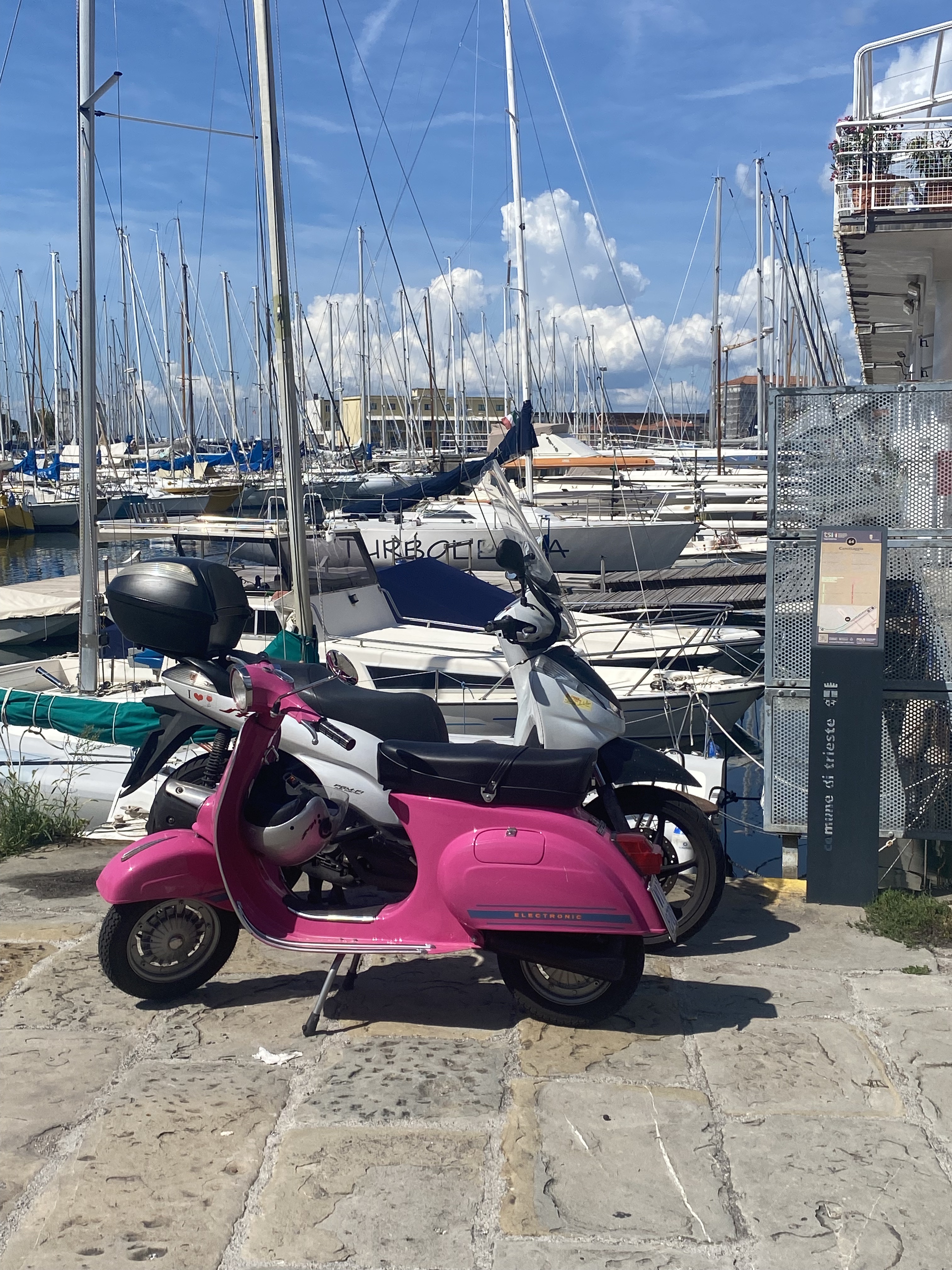
Trieste has always interested me and I’ve had a strong lingering curiosity to see the place. Like others with next to no language skills the sound of the place made me think of the French word tristesse – a state of melancholy or sadness. Its location – surrounded by hills and at the absolute eastern edge of Italy makes it something of an island, joined only to the rest of the country by a narrow strip of land. Once it was the end of Europe, the land after was Yugoslavia & distinctly Iron curtained. for a while after the war ( the second ) it was like Berlin – run by British, Americans & Russians each posturing over which country it should belong to. Before that it was Italian & before WW1 for several centuries The Austrian Empires prize sea-port. Here vessels docked from across the Med & beyond, paddle steamers en route to Suez, freighters to Istanbul or Alexandria. The pride of the Austrian Navy laid up in port, the bustling docks manned & womaned by Turks & Greeks, Slavs, Italians & Albanians. Traders and shipping agents & grandees plied their various trades & built palaces & villas on the proceeds, those with a civic duty or just wishing to be remembered by posterity ploughed money into sculptures or museums or public works of edification. All the good people went to the opera & walked along the esplanade & through the piazzas & squares or journeyed about in their carriages, dressed in the latest Viennese fashions to see & be seen.
That was until June 28th 1914. When in a street in the Balkan city of Sarajevo events took place that changed the fate of Trieste and indeed Europe for ever. The heir to the Austrian throne, Franz Ferdinand was assassinated along with his wife Sophie.
Ferdinand’s body was brought back to Trieste by Naval vessel & a funeral cortege escorted him through the crowded streets before travelling on to Vienna.

Within two months Europe was at war, by the wars end seventeen million were dead, millions more maimed and wounded & Europe was changed forever. This was also the death knell for Trieste – with the collapse of the Hapsburg Empire – what need for a glittering sea port for a Power that no longer existed? Other better harbours along the Adriatic grew at Triestes expense & the old City faded into the twentieth century like an aged Aunt – once the life and soul of the party now tucked up in genteel dotage at a retirement home in Cheltenham.
This is not to say that Trieste is a city that can only look backwards towards the past, the residents & for that matter the tourists give one the sense of people who take pleasure in just simply living. The streets bustle by day & by night, summer evenings are filled with music and chatter, tables spill outside onto streets and groups and couples and what seems like the whole world eats & drinks and mingles on warm dark evenings.
The harbour is awash with yachts & dinghies & power boats – water borne commerce has morphed to pleasure. Ferries take day trippers to islands and along the coast. The cafes by day decant espresso that is as good as any you will find, there’s a long history of Trieste & caffeine – there’s even a festival dedicated to coffee in October. The grand old cafes and restaurants, & smaller local restaurants with simple but delicious peasant style food joints cater for all tastes, step into any one and you’ll probably find that James Joyce was a regular or that Freud was there, or Rilke or Wagner or Hemmingway, or Byron. This place has been a magnet for writers & thinkers and travellers for ever.
The people of Trieste – nicknamed Giuliani – enjoy taking to the waters, outside the town miles of rocky beaches are filled sun worshippers, if you want to go full Commando and getting your kit off then there is somewhere to go, or in need of a dip on your lunch break, easy just nip to La Lanterna, a small bathing club in Town, it’s old, very old, it’s enclosed and divided in two, ladies to the left, gents to the right. a barrier out into the sea prevents mingling until you get into deeper water, its very Hapsburg decorum. A bunch of old Italian gents sit and play cards around a table, in for the day. Bronzed bodies tell who’s a long term resident from the pasty white of tourists. The water is not entirely jellyfish free, as I discovered, but even that experience was gentle enough.

A bus ride out of the City takes you to Mirimare, a castle built by Maximillian, second son to an Emperor. It has stunning views & beautiful grounds.

Maximillian came to a sticky end, shot by firing squad attempting become an Emperor in his own right in Mexico, his wife went mad, every occupier down the years in fact suffered some grisly fate or another, Austrian, Italian, even American Generals occupying the castle after WW2 died horribly, the curse of beautiful Mirimare.
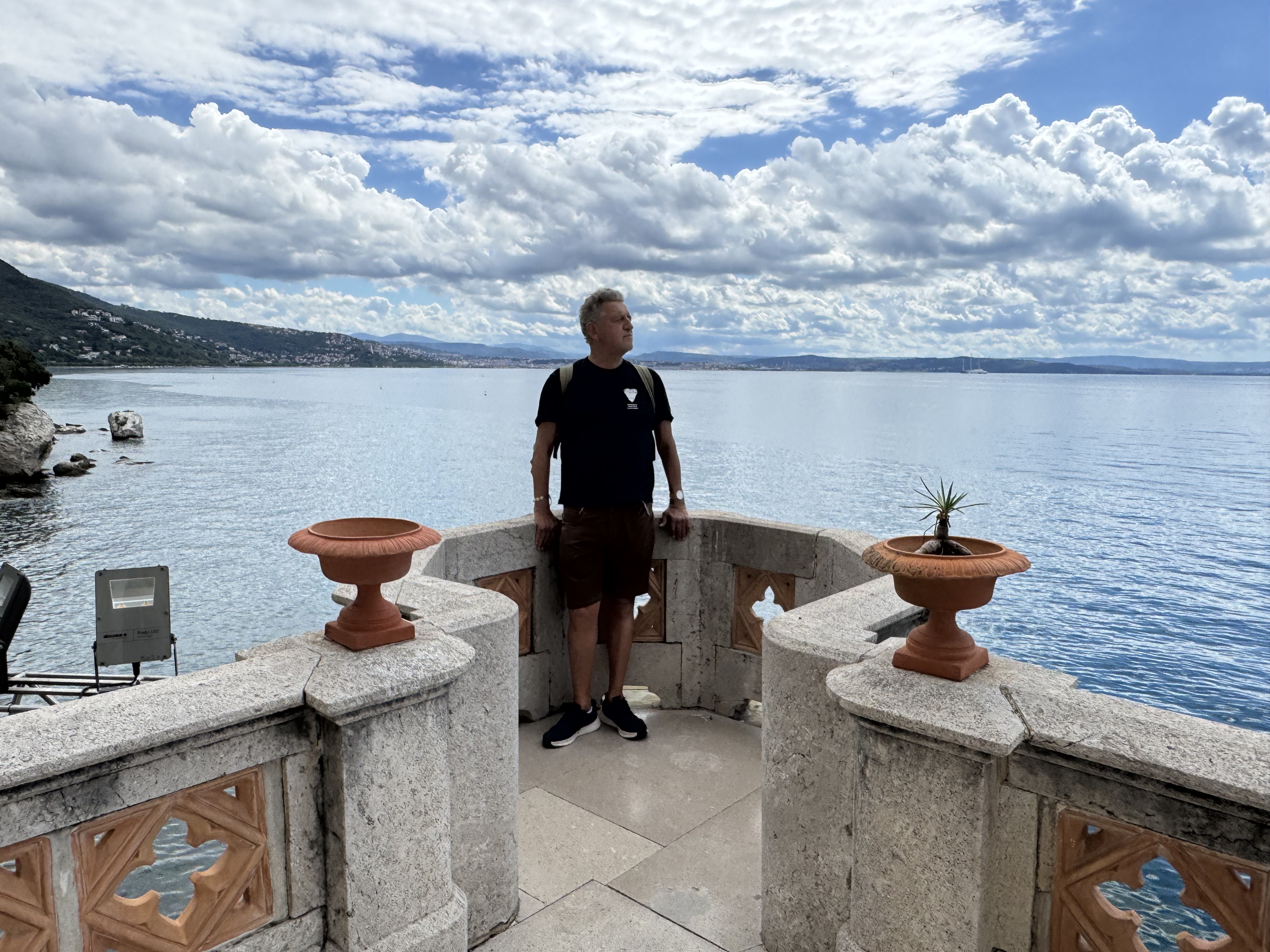
I could write far more about Trieste, the place does enthral me. I have so many memories of a five day visit I don’t know where to begin. So I won’t bother. Instead if you can, go and see it for yourself. For my part whilst reading a book by Jan Morris about Trieste I was taken by the following passage,
“There are people everywhere who form a fourth World, or a diaspora of their own. They are the lordly ones. They come in all colours. They can be Christians or Hindus or Muslims or Jews or pagans or atheists. They can be young or old, men or women, soldiers or pacifists, rich or poor. They may be patriots, but are never chauvinists. They share with each other, across all the nations, common values of humour and understanding. When you are among them you will not be mocked or resented, because they will not care about your race, your faith, your sex or your nationality, and they suffer fools if not gladly, at least sympathetically. They laugh easily. They are easily grateful. They are never mean. They are not inhibited by fashion, public opinion or political correctness. They are exiles in their own communities, because they are always in a minority, but they form a mighty nation, if they only knew it. It is the nation of nowhere, and I have come to believe that its natural capital is Trieste.”
― Jan Morris, Trieste and The Meaning of Nowhere
This says better than I what I’ve found sometimes & enjoy most about travelling and what I desire from it. What did I take away from Trieste? Well lots of books for sure, authors I’ve not read & now will – like Italo Svevo a long term resident. Books and the desire to return. I would go back to linger, to soak into the life, to write a book maybe, or perhaps I’d save the trip & go with someone I was madly in love with. Trieste isn’t melancholy it’s love.

 Sixty & Frisky.
Leave a comment